

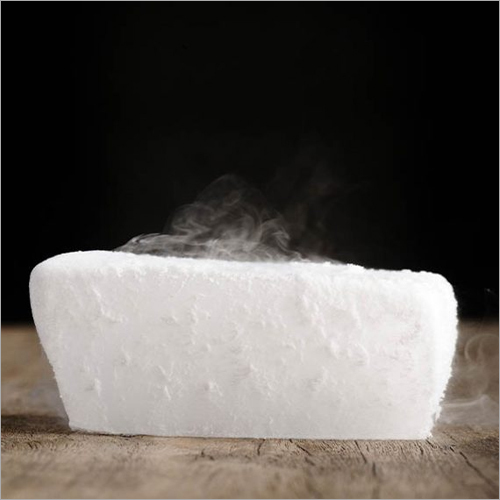
Dry Ice Block
85 INR/Kilograms
Product Details:
- Boiling point Sublimates at -78.5C
- Solubility Insoluble in water
- Ph Level Neutral (pH not applicable for solid CO)
- Taste Odorless and tasteless
- Poisonous No
- Form Solid
- Molecular Weight 44.01 g/mol Grams (g)
- Click to View more
X
Dry Ice Block Price And Quantity
- 100 Kilograms
- 70.00 - 100.00 INR/Kilograms
- 85 INR/Kilograms
- Can cause severe frostbite if touched
- Stable under recommended storage
- -78.5C
- Classified as UN 1845, follows safety regulations for CO transport
- Varies depending on storage; typically hours to days
- Varies by form; typically 3-16 mm pellets
- White
- Insulated container, box, pellet bags
Dry Ice Block Product Specifications
- 124-38-9
- Store in insulated containers, dry, well-ventilated area
- Pellets / Blocks
- Solid
- Sublimates at -78.5C (does not melt)
- Typically >99.9%
- O=C=O
- Industrial / Food Grade
- Carbon Dioxide
- CO
- 1.56 Gram per cubic centimeter(g/cm3)
- Non-flammable gas
- Insoluble in water
- Sublimates at -78.5C
- 204-696-9
- Cooling, freezing, blasting, fog effects
- No
- Neutral (pH not applicable for solid CO)
- Odorless and tasteless
- Meets industrial and food standards
- Carbonic anhydride, CO
- Other
- 44.01 g/mol Grams (g)
- Solid
- Carbon Dioxide (CO)
- 28112100
- Odorless
- Can cause severe frostbite if touched
- Stable under recommended storage
- -78.5C
- Classified as UN 1845, follows safety regulations for CO transport
- Varies depending on storage; typically hours to days
- Varies by form; typically 3-16 mm pellets
- White
- Insulated container, box, pellet bags
Dry Ice Block Trade Information
- 10000 Kilograms Per Day
- 1 Days
- All India
Product Description
Our provided range of Solid Dry Ice Blocks are demand in varied sectors such as hospitality and medical. These are the solid form of carbon dioxide, offers a lower temperature than water ice, and longer holding times and requires no clean-up. Apart from this, offered Solid Dry Ice Blocks can be availed from us in bulk quantity at market nominal price.
Safe Storage and Handling
Dry ice must be stored in insulated containers in a dry, well-ventilated area. Direct contact should be avoided to prevent frostbite. As dry ice sublimates, adequate ventilation is essential to avoid carbon dioxide buildup, which can lead to asphyxiation.
Versatile Applications Across Industries
Utilized for refrigeration, transportation of perishables, laboratory settings, and industrial blasting, dry ice ensures efficient cooling without moisture. Its purity and stability allow use in both food-grade and industrial scenarios, conforming to relevant safety standards.
FAQ's of Dry Ice:
Q: How should dry ice be safely stored and handled?
A: Dry ice must be stored in insulated containers, placed in dry and well-ventilated areas. Avoid direct skin contact as it can cause severe frostbite. Always use protective gloves or tools when handling.Q: What is the sublimation point of dry ice and why is it important?
A: Dry ice sublimates at -78.5C, transitioning directly from solid to gas without forming a liquid. This property is crucial for applications where moisture-free refrigeration or fog effects are required.Q: Where is dry ice commonly used?
A: Dry ice is frequently used for shipping perishable goods, industrial cleaning, laboratory experiments, and creating fog effects for entertainment purposes due to its rapid cooling and sublimation abilities.Q: What benefits does dry ice offer over conventional ice?
A: Dry ice cools more rapidly and leaves no liquid residue as it sublimates. It is odorless, tasteless, and highly effective for maintaining very low temperatures, especially in transport and storage of temperature-sensitive items.Q: When should industrial versus food-grade dry ice be chosen?
A: Food-grade dry ice should be used for applications involving food transport or direct contact with consumables, while industrial grade is suitable for cleaning, blasting, or other non-food industrial processes.Q: Can dry ice be transported by regular means?
A: Dry ice is classified under UN 1845 for CO2 transport and must follow specific safety regulations to ensure proper handling and ventilation during shipping, including appropriate labeling and packaging.Tell us about your requirement

Price:
Quantity
Select Unit
- 50
- 100
- 200
- 250
- 500
- 1000+
Additional detail
Mobile number
Email

Other Products in 'Dry Ice Blocks' category


BOSTEC CRYOGENIC GASES
GST : 26ABFHS7816C1Z3
GST : 26ABFHS7816C1Z3

- B No. B-51, Arpan Complex, Nizampura, Daman - 396210, India
- Phone : 08045804655

- Ms. Swapna Basu Basu (CEO)
- Mobile : 08045804655
- Mr. Rakesh Patel
- Mobile : 08045804655
- bosteccryo@gmail.com
 Send Inquiry
 Send Inquiry
 Send SMS
BOSTEC CRYOGENIC GASES
All Rights Reserved.(Terms of Use)
Developed and Managed by Infocom Network Private Limited.
Developed and Managed by Infocom Network Private Limited.

